Costs and Contracts
4 min
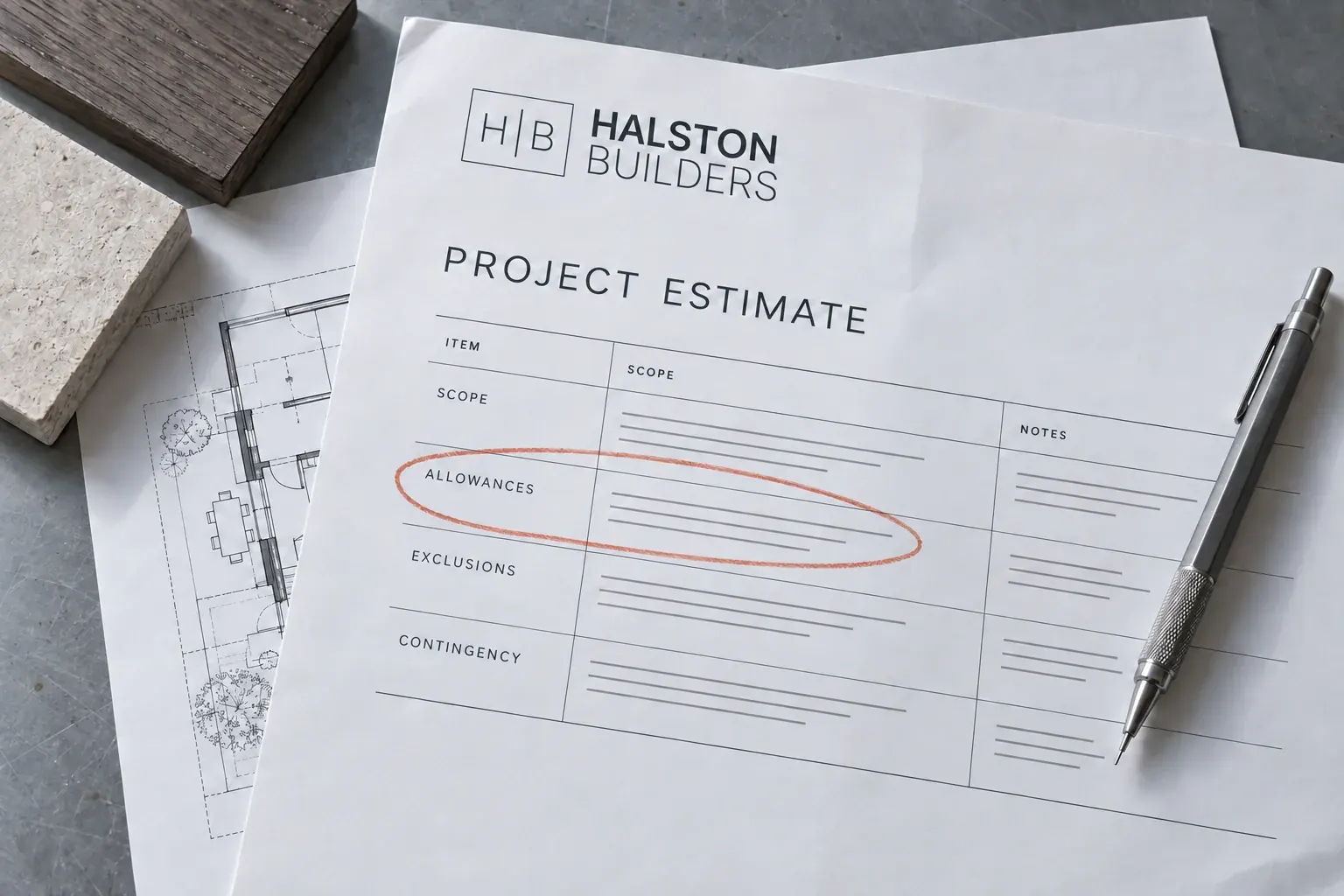
Compare renovation estimates by scope, allowances, contingency and exclusions. Learn which questions reveal what a builder's price includes before you commit.
Estimates for the same renovation can vary substantially because builders have made different assumptions about scope, materials, site conditions or risk. Before comparing totals, establish whether they have priced the same work.
Here is how to tell what you are looking at.
Compare the scopes before the totals. Check demolition, disposal, temporary protection, structural work, building systems, permit fees and site management. A lower number may simply include less work.
This is where most of the gap lives. A builder who has excluded the electrical panel upgrade that the job will certainly need is not cheaper; they are less complete. The work does not go away, and it will arrive as a change order at a worse moment.
Allowances are the easiest place for an estimate to look competitive without being competitive.
Ask, for each significant allowance: what does this number buy? At this tile allowance, which tile could I choose? At this lighting allowance, how many fixtures and of what kind? If a builder cannot answer specifically, the allowance is a placeholder chosen to make the total work rather than to reflect what you want.
Check also whether it covers labor or material only, and whether an underspend comes back to you.
On a renovation, particularly of an older house, an estimate with no contingency is incomplete rather than lean. Nobody can price what is behind a wall that has not been opened, and pretending otherwise is a choice about who carries that risk.
A named contingency, with a stated purpose and honest reporting against it, is a sign of a builder who intends to tell you the truth as the job goes.
Broadly there are two shapes.
Fixed price establishes a price for a defined scope, subject to the contract's allowances, exclusions and change provisions. It suits well-defined work, but it does not mean that every future discovery or requested change is included.
Cost plus links payment to actual costs and an agreed fee. Some agreements also set a maximum. Ask how costs will be documented, what the fee covers and how any limit applies to unresolved work.
Neither is inherently better. What matters is that you understand which one you are being offered, and that the builder can explain plainly why it suits your project. If a fixed price is being offered on a gut renovation with no contingency and a set of drawings that are not finished, something has to give, and it will not be the builder.
Read the exclusions before the total. Landscaping, window treatments, appliances, audio-visual systems, furniture, permit fees and utility charges may be priced separately. Make sure you know who is carrying each cost.
Not always. Sometimes a lower number reflects genuinely lower overhead or a builder who wants the job.
But a number substantially below the others usually reflects one of three things: a scope that is missing something the others included, allowances set low, or a builder who has not properly investigated the existing conditions. All three arrive later as change orders, and change orders in the middle of a project are priced under less competitive conditions than the original bid was.
The lowest estimate matters less than the one most likely to resemble the final invoice.
The answers matter more than the totals. A well-run project at a slightly higher number beats a badly-run one at a lower number every time, and the estimate is the first evidence you have about which you are buying.
More on what moves the number in what drives renovation cost, or request a consultation and we will walk your house and give you a range with its assumptions written down.