Westchester County
New York
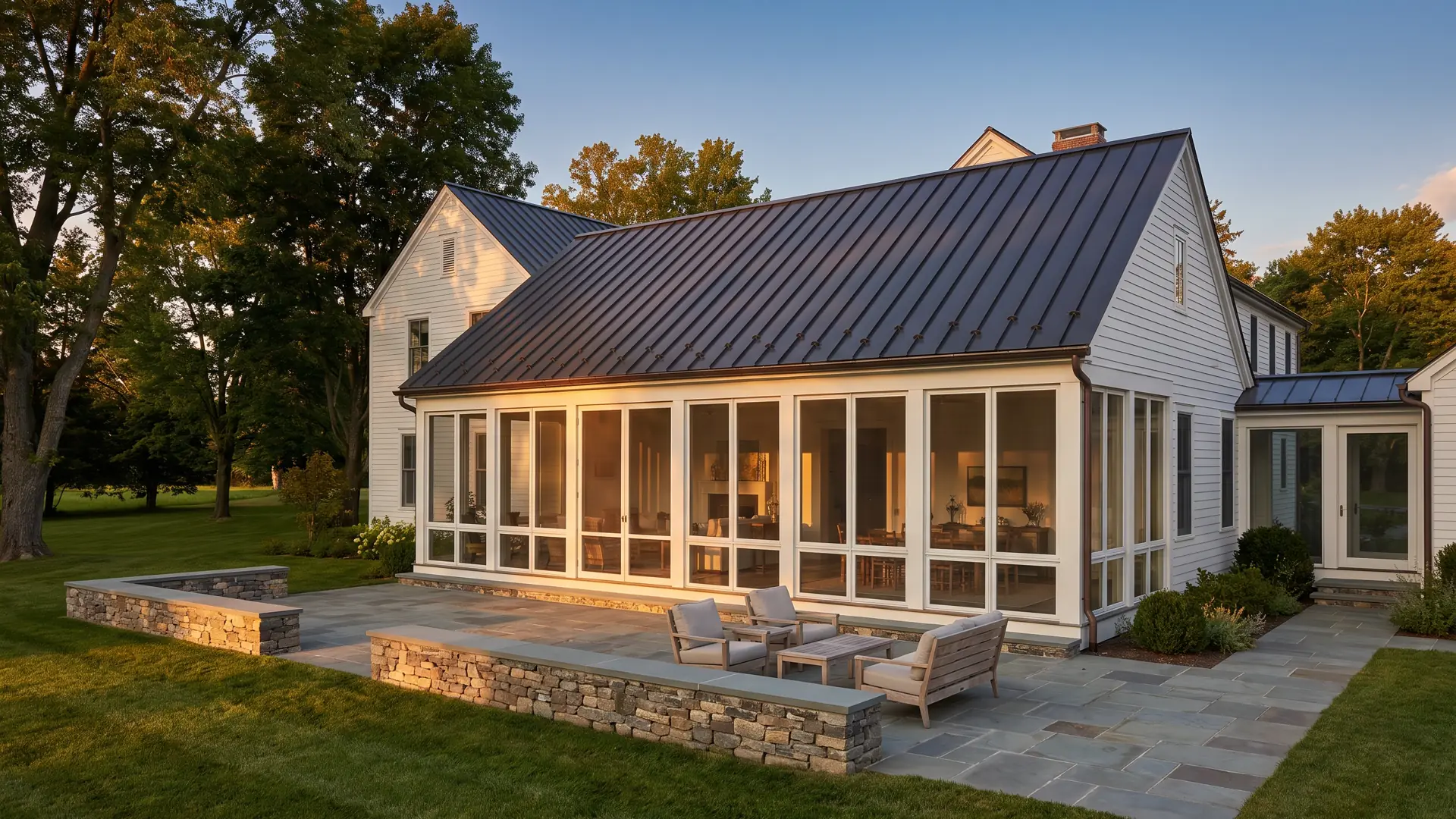
Architecture shown is a design reference, not a documented Halston Builders project in this town. Explore our project portfolio.
Custom homes, renovations and additions in Pound Ridge, NY, planned around wooded lots, stone walls, wetlands, septic and the town's approvals from the start.

Halston Builders is an owner-led design-build firm working in Pound Ridge, where a project can involve the land as much as the house: trees, slopes, wetlands, stone walls, a well and a septic system. One team plans the design, the town approvals and the construction with you, from the first meeting to the final walkthrough.
We build custom homes, including replacements for houses that no longer suit their sites, and take on whole-home and gut renovations of houses worth keeping. An addition might be a primary suite, a family room that opens to the yard or a garage with rooms above.
We also renovate kitchens and baths, including tadelakt lime-plaster bathrooms and steam showers, finish lower levels, and build pool houses and outdoor living spaces such as bluestone terraces and outdoor kitchens. On a wooded lot with slopes or a wetland nearby, the land often decides where a terrace or a pool can go before the drawings do.
Pound Ridge is a town in Westchester County that includes the hamlets of Pound Ridge and Scotts Corners. Nearly all of its homes are single-family detached houses, according to census estimates compiled by the county's planning department, and the county's hazard mitigation plan notes that new construction is rare and usually limited to single-family houses. Much of the housing stock dates from the 1960s through the 1980s, with a smaller share built before 1940.
The Pound Ridge Historic District, listed on the National Register of Historic Places, runs roughly along Pound Ridge, Old Stone Hill and Salem roads, Trinity Pass and Westchester Avenue. Its buildings span from the mid-18th century to the 1940s, in Colonial Revival, late Victorian and mixed styles.
A house from the 1960s or 1970s may still have original wiring, windows and mechanical systems, and our guide to renovating a mid-century modern house covers what to check. An older farmhouse may have stone foundations and many rounds of repairs, and our article on what to keep in an old house explains how we decide what stays.
The Town of Pound Ridge handles its own building and land use approvals, and more than one board can be involved in a single residential project. Items to confirm early:
Each board keeps its own calendar and deadlines, so we map the approvals with your design team before the drawings are final. Our articles on permits and approvals explain the wider process.
Stone walls. Pound Ridge's historic districts law names stone walls among the features it protects, and on a landmark site, removing or substantially changing one counts as an alteration. On any property, we locate the walls on the survey before placing a drive, a septic field or a terrace, because moving or rebuilding one takes time and skilled masons.
Trees and wooded lots. Trees above a set size on sloped ground, near property lines or in wetland setbacks, specimen and protected trees, and clear-cutting all need a tree removal permit. The Building Inspector decides most applications, and trees in a site plan or subdivision go to the Planning Board. The county's hazard mitigation plan notes stands of dead or diseased trees in town, so an arborist's review before construction is worth considering.
Steep slopes. Filling, excavating, regrading or clearing a steep slope needs a steep slope permit. The Building Inspector first determines whether the work will disturb one, and the Planning Board decides the permit after a public hearing. Customary landscaping without regrading is exempt.
Wetlands. The town's wetlands ordinance protects its ponds, lakes, streams and wetlands and its surface and ground water. Driveways, accessory buildings, depositing material and clearing within the regulated area all need a Water Control Commission permit.
The watershed, septic and wells. Portions of Pound Ridge drain to New York City's Cross River Reservoir. In the city's watershed, the Department of Environmental Protection must approve new septic systems and alterations to existing ones, and in Westchester the County Health Department reviews these applications for the city. Town law also requires owners on septic to have the system inspected and pumped on a regular cycle by a county-licensed septage collector. Drilling a new well needs a permit from the Building Inspector.
We start by walking the property with you and gathering what already exists: the survey, septic and well records, any drawings, and which trees, slopes and walls matter to you. Our design-build process develops the design and the approvals together, and pre-construction budgeting prices each stage so scope and cost stay in step. If you have already engaged an architect, we can build to your architect's drawings.
It depends on the property. On a designated landmark site or in a designated historic district, removing or substantially changing a stone wall is an alteration and needs a certificate of appropriateness where the change can be seen from a public road. Anywhere in town, also check whether the new drive touches wetlands, steep slopes or trees that need a permit.
In many cases, yes. Dead trees and trees that endanger people or property are exempt, but most other removals on slopes, near property lines or near wetlands need checking. We mark the trees the work would affect early, so the permit is part of the plan.
Work that would fill, excavate, regrade or clear a steep slope needs a Planning Board permit, decided after a public hearing. A topographic survey early in design shows where the house, an addition or a terrace can sit with the least disturbance.
Possibly, with a permit. Work in or around a wetland, pond or stream, within the controlled area or its setback, needs a Water Control Commission permit. Locating the wetland first lets the design place new work where it has the least effect on it.
Settle the septic question first. In the city's watershed, a new bedroom means the septic system is reviewed as an alteration, and the County Health Department carries out that review for New York City. Pulling the county's records for the system and the well at the start tells us whether the system can stay as it is, needs to grow or has to move.
Check with the town. The Pound Ridge Historic District is on the National Register, and the town's own law covers designated landmarks and historic districts. For a designated property, exterior work visible from a public road needs a certificate of appropriateness, and replacing entire windows is not an ordinary repair.
Yes. Send us the current set and the survey, and we will review them with your architect, raise questions about the site, the septic system or the approvals, and price the work. Roles for approvals, selections and site decisions are agreed before construction starts.
We start from a defined scope and show allowances, exclusions and open site questions separately. In Pound Ridge, the septic system, the well, tree work, wall repairs and the driveway can carry real cost, so we investigate them before the budget is presented as firm.
We also build in Bedford, New Canaan, Stamford, Armonk and Ridgefield. Every town we cover is listed on our Westchester County page and on the service area page.
Request a free consultation. We can meet at the house in Pound Ridge and walk the property with you, or at our design center at 46 Beatrice St, Unit 2, in Bridgeport, by appointment. Bring the survey and any drawings or septic and well records you have.