Fairfield County
Connecticut
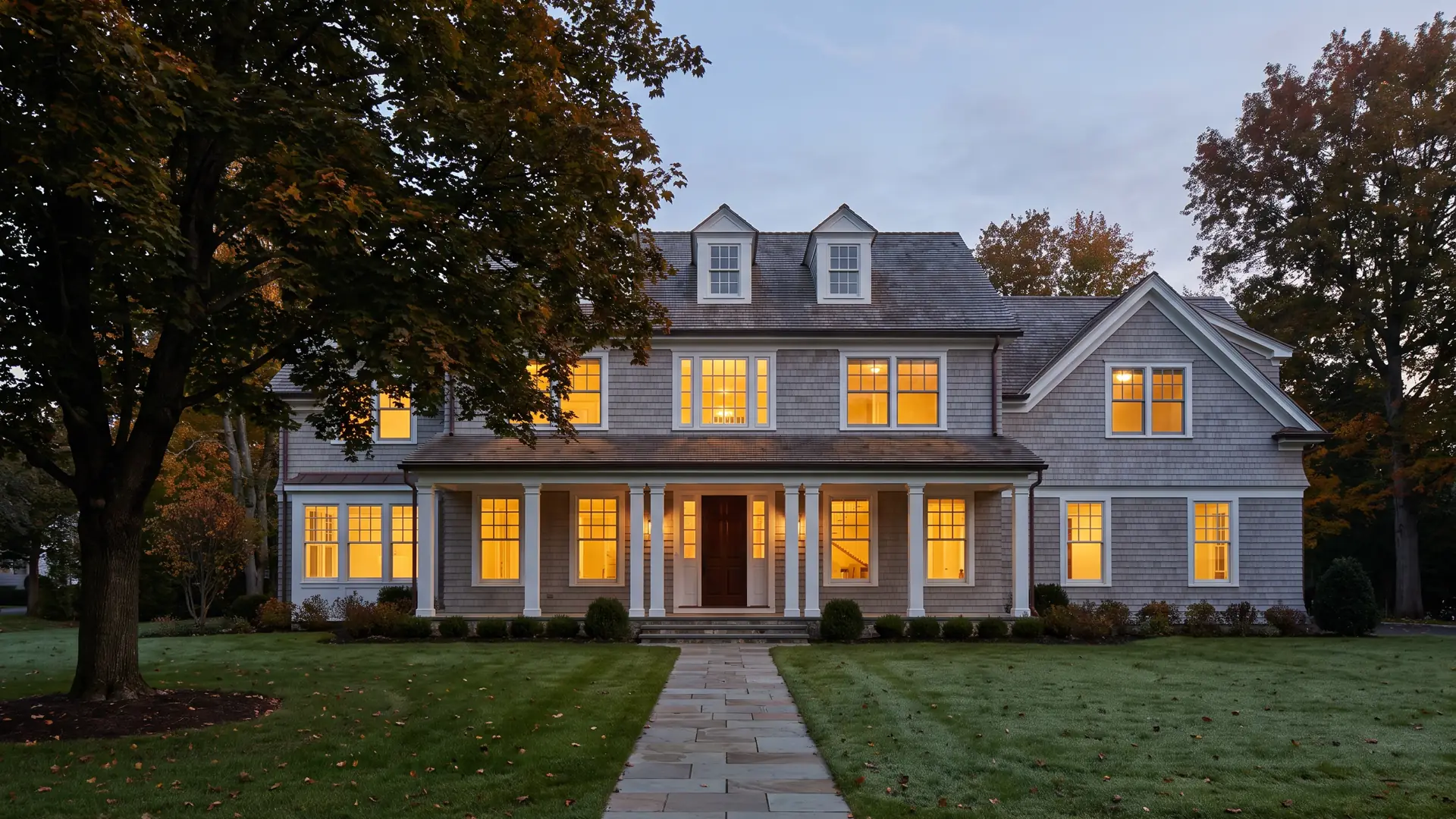
Architecture shown is a design reference, not a documented Halston Builders project in this town. Explore our project portfolio.
Custom homes, renovations and additions in Ridgefield, CT, near Main Street, by the lakes and on scenic roads, with one team from design to the walkthrough.

Halston Builders is an owner-led design-build firm working in Ridgefield, from houses in the historic districts near Main Street to properties by the town's lakes and along its scenic roads. One team carries the work from the first meeting to the final walkthrough, and the permit and approval steps are mapped with your design team before anything is built.
We build custom homes and take on whole-home and gut renovations of older houses that need new systems, a better plan or both. Additions are a large part of the work: primary suites, family rooms off the kitchen, garage and mudroom wings, and second floors.
We also renovate kitchens and baths, including steam showers and tadelakt lime-plaster bathrooms, and finish lower levels. Outside the house, we build pool houses and accessory structures and outdoor living spaces such as terraces, outdoor kitchens and pool surrounds.
Ridgefield is mostly single-family houses, about four in five housing units according to the town's 2020 plan of conservation and development. The plan credits historic buildings and sites with a major part of the town's character, and it counts stone walls, barns and designated scenic roads among the features worth keeping.
Two kinds of historic district apply here, and they work differently. The plan lists National Register districts at Ridgefield Center, Weir Farm, West Mountain, Titicus Hill and Ridgebury, which it calls recognition districts. The regulatory districts are local ones, overseen by the Historic District Commission, whose property lists cover the Main Street, High Ridge and East Ridge Road districts and a few individually designated properties. The plan also lists individually significant buildings such as the Keeler Tavern and the Governor Lounsbury House.
Ridgefield has a number of lakes, among them Lake Mamanasco and Great Pond, and the plan notes that these areas have long attracted residential development.
Ridgefield's Planning and Zoning Department includes zoning, wetlands and planning staff, and land use reviews start there. Items to confirm early:
Our permits and approvals guides cover how to order reviews like these so the schedule allows for each board's meeting calendar.
The 2020 plan describes Ridgefield as sitting at the top of several watersheds. Much of the town drains to public water supply reservoirs that serve Ridgefield and other communities, among them Danbury, Norwalk, Wilton, New Canaan, Stamford and New York City, and the town administers both state and local aquifer protection regulations. Drainage, erosion control and work near wetlands get close attention as a result.
Lake properties need particular care. The plan notes that Ridgefield's lake associations, starting with the Mamanasco Lake Improvement Fund, promote measures such as keeping a vegetated buffer around the water, and it names septic systems among the sources of nutrients that affect lake water quality. On a lake lot, a septic upgrade, new drainage or planting along the shore may belong in the plan.
The town publishes a sewer map, so confirm early whether the house is on sewer or septic. For a septic property, the Health Department's first step for the owner is soil testing by a professional engineer or a licensed septic installer, and a town sanitarian observes the soil conditions in the deep test pits and the percolation testing. The department also approves the location and construction of private wells, requires a water analysis on a new well before final approval, and recommends that well owners test their water every year.
The plan's natural resources maps show wetlands, flood plains and steep slopes across the town. Check the property on FEMA's flood maps and raise any slope or wetland questions with the wetlands staff before the site plan is fixed.
Our design-build process brings design, approvals, budget and construction under one team. Early on we gather the survey, the septic and well records and any historic district information, so the design responds to the site. Pre-construction budgeting tracks cost as the drawings develop, and if you already have an architect, we can build to your architect's drawings.
It depends which kind. National Register districts, such as Ridgefield Center or Titicus Hill, recognize historic significance, while the local districts are where the Historic District Commission reviews exterior work, including fences, driveways, garages and sheds. Check the commission's property lists, and notify the commission before work begins if the house is on one.
Ridgefield adopted a demolition delay ordinance in 2020, so ask the Building Department early whether it applies to the house. In a local historic district, demolition also needs the Historic District Commission's review. The septic and well records, wetlands on or near the lot and the zoning review all shape what can replace the house.
Often, once the septic question is answered. The Health Department requires a code-complying septic area to be found and reserved before an addition or conversion is approved, and that usually starts with soil testing by an engineer or licensed installer. We put this at the front of the schedule because it can change the size or position of the addition.
Expect closer attention to septic performance, drainage, erosion control and the shoreline. Work near the water or any wetland may need an Inland Wetlands Board permit, and the lake associations encourage a vegetated buffer along the shore.
Possibly. Disturbing, filling or removing soil in or next to wetlands and watercourses is a regulated activity in Ridgefield. Some projects can go through an administrative permit, and the wetlands agent can tell you which route applies once there is a site plan.
It depends on the septic area, the zoning review, the wetlands and the house itself. Building up keeps the footprint and leaves the yard, including any septic reserve area, as it is, though the health review still applies. Building out can suit a one-story plan or a house whose walls and foundation were not built to carry another floor. Our guide to building up or out walks through the trade-offs.
Yes. We price from your architect's set and raise our questions before construction rather than during it. Responsibility for drawings, approvals, selections and site decisions is agreed at the start.
That depends on the scope and on how well the work area can be separated from daily life. Phasing, a temporary kitchen, dust control and safe access all come into it, and larger projects often mean moving out for part of the work.
Pricing starts from a defined scope and gets firmer as drawings and site investigations develop. The schedule allows for health, wetlands, zoning and historic district reviews, each on its own calendar, before the building permit is issued.
We also build in Wilton, Weston, New Canaan and Pound Ridge. Every town we cover is listed on our Fairfield County page and on the service area page.
We can meet at your house in Ridgefield or at our Bridgeport design center, 46 Beatrice St, Unit 2, by appointment. Bring any survey, septic records or drawings you have. Request a free consultation.